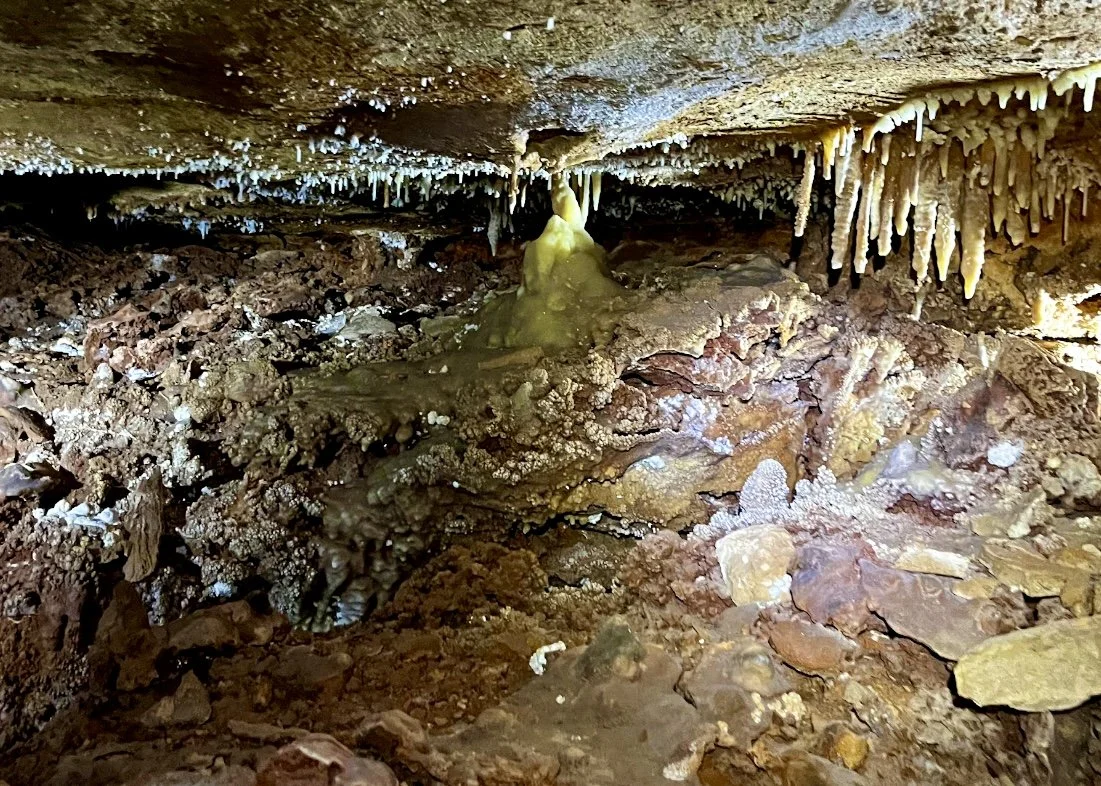
North of Austin, a construction crew worked their tools into the ground. Drilling into the Earth, through karst bedrock underlying the Edwards Plateau, the workers pressed into the soft rock with their man-made machines, pushing down until finally—pop! Hollow. They broke ground and the limestone gave way. There was nothing underneath.
Two months ago, I was sitting at my computer when a notification popped up on my screen. Curious, I opened it immediately. It was an email asking if my research group was interested in visiting a grouping of caves discovered on a construction site five days prior. As I read through the lines, my initial excitement fizzled into a dull ache. Construction plans mandated the caves to be sealed with concrete within a week. Only 13 days marked the discovery and subsequent end of these formations. I quickly shut my computer and began planning my trip.
Two days later, I was on the road with a van full of worn tools and mud-covered cave gear. After almost a year studying the growth dates of cave formations, it was dizzying to head towards a site with a marked end date. It felt sacrilegious to accept the idea that these caves would no longer exist in a few days. As we drove, I became all too aware of my scientific omnipotence. A 19-year-old with a helmet a half size too big, hand-me-down hiking boots, and a half-squished sandwich packed for lunch. Why should I have so much power over these caves? I was painfully aware of my ability to study and sample and analyze the caves as I best saw fit, and yet I felt helpless to save them from their inevitable demise.
My thoughts swirled as we pulled our van onto the site, tires kicking up dust and fine dirt into the air. Our research group met with environmental consultants who showed us around the property and provided valuable context for our studies. They had drafted rudimentary maps of each cave, with a few more finished than others, and handed us a pen and a clipboard to continue mapping anything of note. Admittedly, I did little mapping on this trip. What I did observe was far too mesmerizing for cartographic scribbles to do any justice.
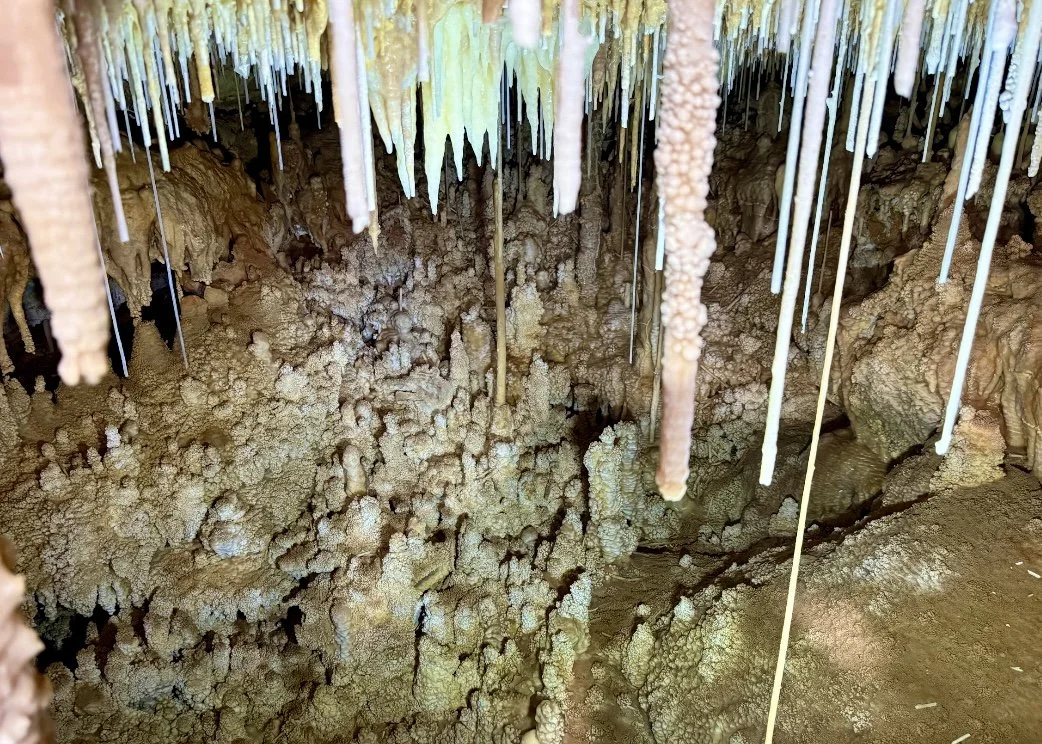
Skinny, hollow stalactites that decorate the ceiling are called soda straws. They were named because, in theory, (please do not do this) you could snap one off and drink soda through it.
The caves were small, and most of them required me to hunch down, but the closeness felt crucial to the experience. The sweat-slicked crouching forced me to come face-to-face with the detail of the caves. They each held beautiful glittering stalactites and stalagmites, also called speleothems, growing from the floors and ceilings. Several caves featured large columns, others had spiky, alien-esque helictites, and a few had flowing curtain-like formations draping from the ceiling like a beautiful ribbon. Thousands upon thousands of soda straws, named after their hollow straw-like appearance, hung from the roof of the caves and glistened in the light. Each cave was unique in its own way, and the image of them is forever imprinted in my mind.
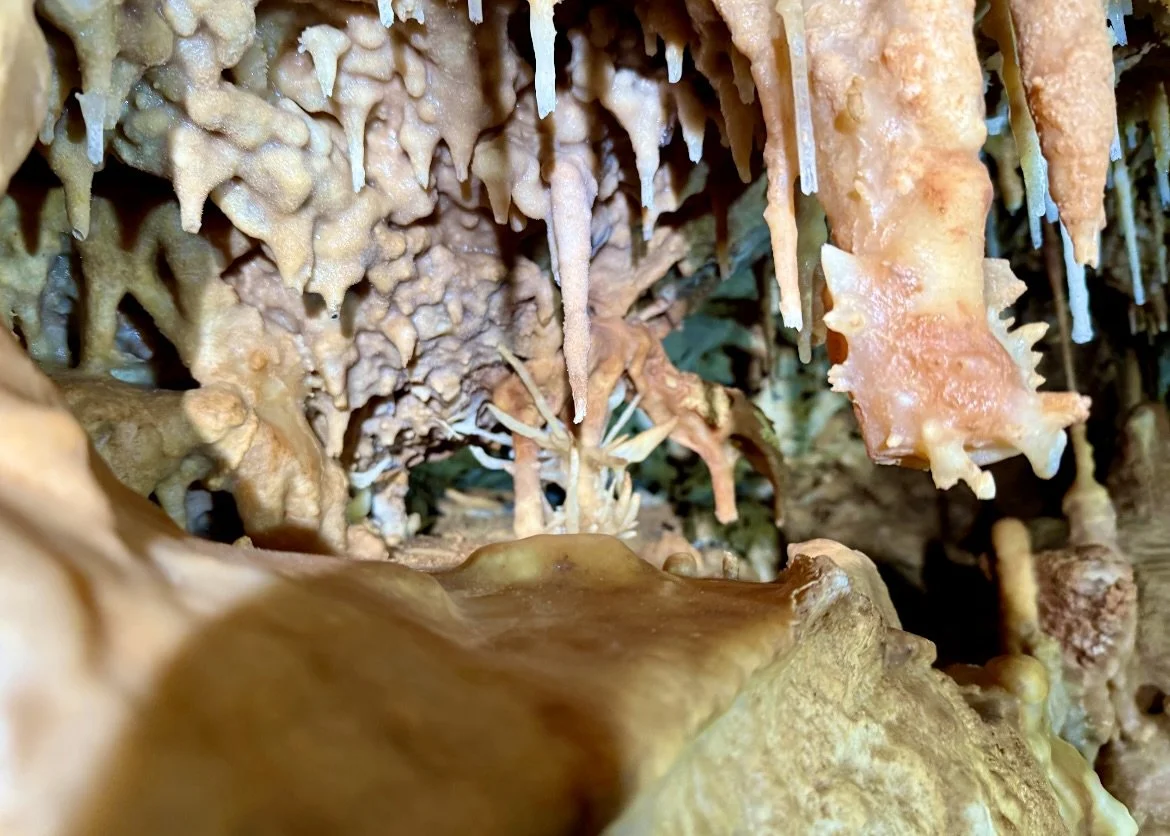
These spiky, gravity-defying formations are called helictites. The mechanisms of their formation are still being researched, but the leading theory is that they form through capillary action.
Construction workers soon came in droves, collecting whatever they could before the caves’ destruction. They tore off their sweat-soaked gloves, stuffing their pockets with fragile speleothems, small trophies glittering in the sun. “Esto le encantará a mi hija,” one man said to me, a triumphant grin across his face. “My daughter will love this one.” The irony of it all was not lost on me: These men who had so much respect for these features, wrapping sparkling rods in dirty blue shop towels. The care of preservation in the gentle, calloused hands of the craftsmen who were ordered to destroy it all. It was a bittersweet day on the site as we preserved what we could.
I am grateful I was not present on the day they destroyed them.
Gratitude seemed to be a common denominator on the construction site. It’s sobering to be one of the first people to ever step foot within a cave, and also one of the last. I find myself baffled by how intricately detailed a cave can be, and all too surprised at how quickly it puts you in your place. The sight of an untouched cave, growing silently for hundreds of thousands of years, reminds us we are but a scratch on the surface of the Earth. Hundreds of years of social conditioning have fooled us into believing humans are the reason the world goes round. As if humans are a superior being. In actuality, we are nothing more than a fleeting moment. Man and dinosaur have much more in common than you might think, each basking in temporary preeminence while standing on borrowed time.
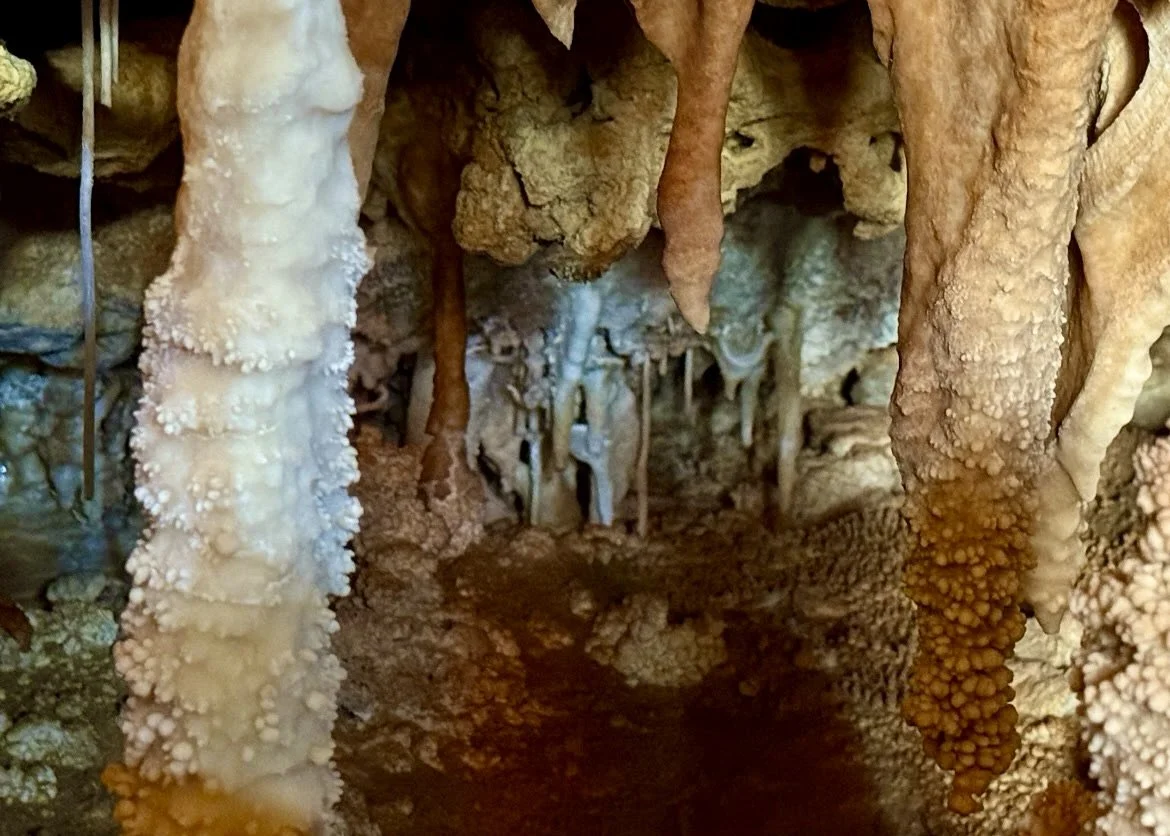
Appropriately named, these small, white clumps are called cave popcorn. I would not recommend trying to eat them, though.
In the days since my trip to the caves, I’ve found myself thinking in circles about what it all means. We arbitrarily assign these values to the natural world around us, as if existing within our gaze gives it meaning. As if our perceiving the world is what makes it important. If a tree falls in the forest, and no one is around to hear, does it make a sound? Is it meaningful? If a cave exists below our feet, dazzling and shining amid the dark and damp, but no one has ever laid eyes on it, is it important? Does it have meaning? Does it exist? Maybe Schrödinger was onto something. Maybe a cat in a box is both alive and dead. Maybe an unopened cave beneath our feet is both meaningful and nothingness.
Disclaimer: These are extremely extraordinary research circumstances, and should never ever be replicated. Should you ever discover a cave yourself, you should touch nothing, take only photos, and leave no trace behind. Don’t try to play God.