Planting a single tree is a strategic choice that impacts one campus, over a hundred buildings and thousands of people every day at The University of Texas at Austin.
UT Austin reports that it maintains 4,581 trees with over 100 different species, as of 2026. However, there is a vast difference between the number of fruit-bearing plants and shade trees. Treekeeper.com, UT Austin’s online interactive tree inventory, records 1,982 southern live oak trees but only 13 edible Fig trees.
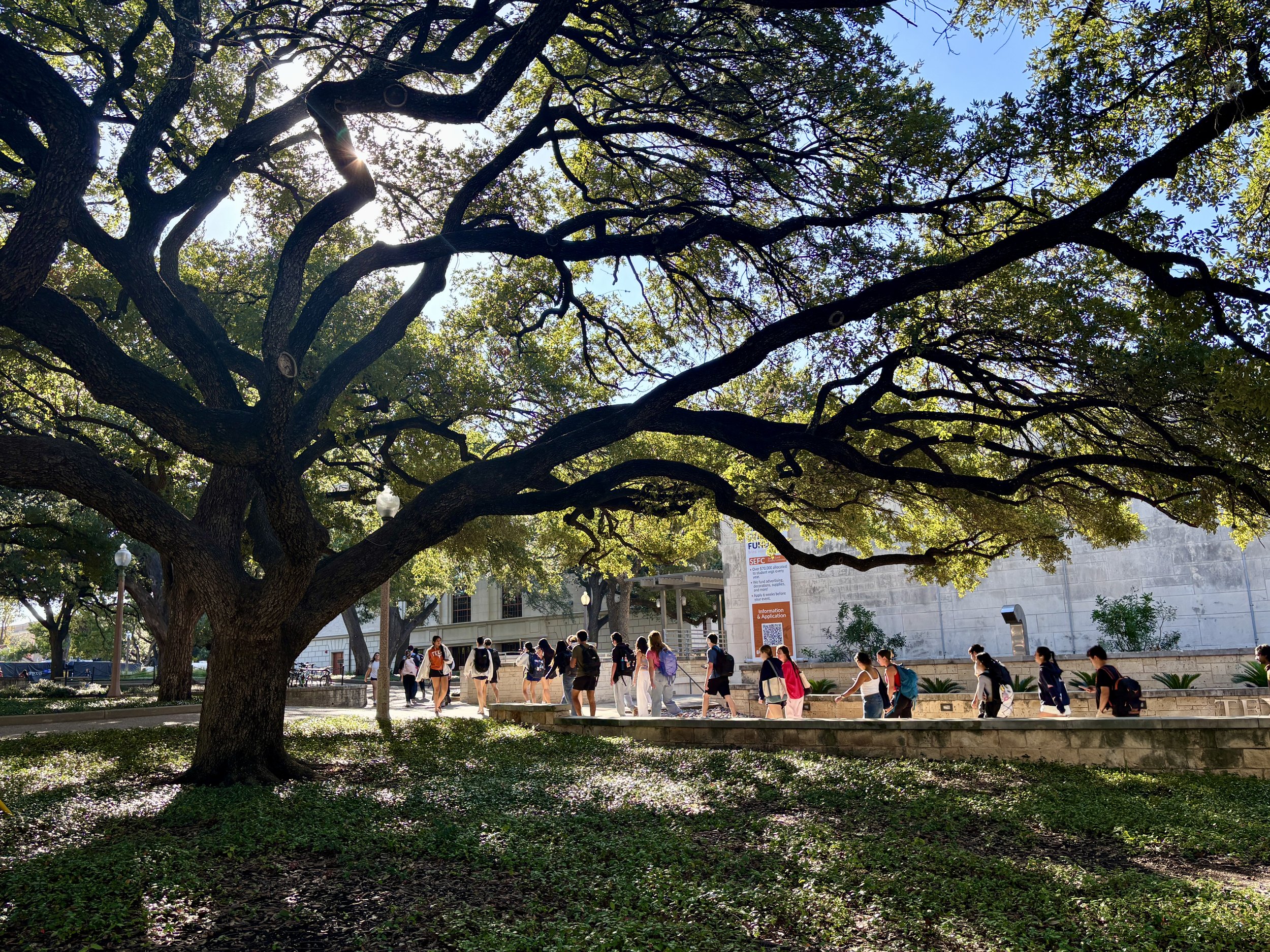
Students walk past Texas live oak trees outside The University of Texas at Austins Union on Nov. 4, 2026. Emily Ramirez/Drift Magazine
According to Sam Carse, Assistant Director of Grounds and Landscape for The University of Texas at Austin, the southern live oak is our campus’ largest volume tree species because of local site conditions and maintenance difficulty level.
The decision process factors in local site conditions including solar exposure, irrigation systems, soil type, soil depth and whether the site is wet or dry. It also considers whether it’s an upright species that responds well to pruning.
“Right tree, right place,” said Carse. “And what that says is you need to make sure that the site itself is suitable for what you want to plant.”
Southern live oak trees are native plants better adapted to the hot, dry Texas weather. Their leaves maintain a thick wax coating which preserves moisture and contributes to their drought tolerance.
“I call it the bread and butter tree because it does the best. It takes the drought the best. It takes construction impacts the best to its root system,” said Carse.
On the other hand, most fruit trees aren’t as drought-resistant and their low-hanging branches often require more pruning from UT groundskeepers.
Despite these disadvantages, fruit trees such as Mexican plum, persimmon and pomegranate reside in the UT Orchard. Why? These varieties are either easier to prune or tolerate the Texas heat. Most notably, they diversify the tree canopy, according to Sam Carse.
“Diversity is the best approach for a host of things–for the ecosystem, for insects and disease, and just, I think, for longevity,” said Carse.
The UT Grounds and Landscaping team carefully chooses vegetation most likely to survive, so diversified green spaces can exist on campus. Urban green spaces, open areas reserved for vegetation like trees or grass, provide a host of ecosystem services benefiting local land temperatures, air quality and land erosion.
“The roots of a tree will extend two to three times out past that edge of canopy—or drip line, we call it. So that one tree, that one large mature tree has the potential to impact thousands and thousands of square feet or square footage of soil area. And that on a creek in a riparian area, that's super important because what we're trying not to do is lose bank stabilization,” said Carse.
As climate projections predict Austin temperatures will continue to rise with increased emissions, the conservation of large mature trees with developed root systems becomes increasingly vital to sustainable landscaping practices.
“They can reduce energy usage in buildings, both in summer and in winter,” said Carse. “They let sun through so they can help reduce your heating costs. And then obviously in the summer with shading.”
A large diversified tree canopy not only counteracts local warming, but it also targets the root cause — air pollution like ground-level ozone and particulate matter emissions.
“Their leaves and their canopy capture pollutants like ozone, particulate matter. Urban areas that have diverse tree canopy typically have better air quality,” said Carse.
The indispensable benefits of trees are why UT grounds and landscaping team plans to repurpose or improve existing campus areas to further develop green spaces. While the team has already begun native pollinator plantings and invasive species removal, they plan to continue landscape services with areas like the hillside west of Clark Field and Waller Creek corridor.
“It's a very tight campus, so we have a couple of options where we can convert grass and lawn areas or the areas that don't have any irrigation to them that we can maybe do some more native pollinator plantings,” said Carse. “Along with really trying to be conservation-minded and sustainably minded when it comes to how we protect and preserve or possibly move large trees.”