As bees start buzzing in the spring, UT Austin students, professors and landscaping employees gather to answer the question: Is their campus actually pollinator friendly?
Beevo Beekeeping, a UT organization, is renewing the campus's BeeCampus certification awarded by the nonprofit Xerces Society. The society recognizes campuses that are pollinator-friendly and conservation-forward. The renewal requires documenting landscaping practices and reductions in pesticide use, as well as determining if there are courses that actually teach students about pollinators and how to protect them.
Beevo's vice president, Kaitlyn Yacenda, said the BeeCampus certification is important beyond the title of a pollinator-safe campus. The certification requires the organization to report their conservation projects, which highlight the work they do year-round. "It really ends up being a summation, a physical thing we can show," Yacenda said. "No one else from the public really sees [what we do], whereas having BeeCampus and showing that it's our work gives us that."
Beevo Beekeeping takes on a significant portion of responsibility for the renewal process. Since UT Austin does not fund the certification, Beevo pays the annual fee in addition to renewing the process.
One requirement of that process is verifying if the campus offers coursework on native pollinators. A popular program that fulfills this requirement is the Freshman Research Initiative stream Bugs in Bugs, run by research professor Jo-Anne Holley. The students in the lab focus on hands-on learning, including dissecting bee intestines and using lab techniques to identify the bacteria living inside them
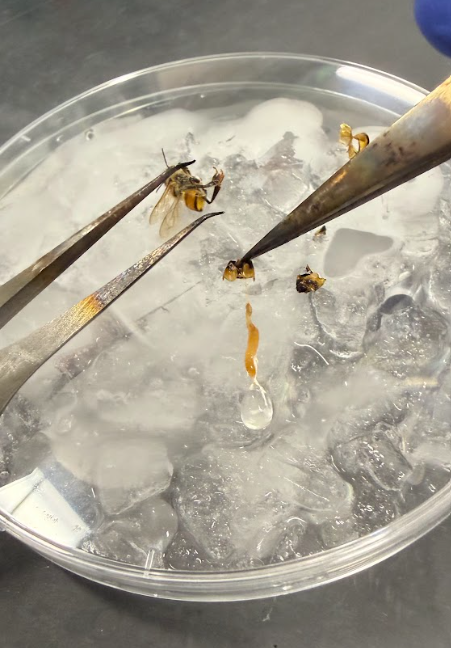
A Bugs in Bugs research student dissects a bee gut to research its microbiome.
"We are interested in bacteria that have consistent relationships with insects because we think there might be some benefit or at least some biological reason that they're associated with each other," Holley said.
This work may seem like a simple activity to introduce freshmen to lab techniques, but it is important for bee health. Research, like the dissections done in these labs, has found that a bee’s digestive system plays a direct role in how they fight pathogens. Holley specifically says glyphosate, the active ingredient in popular pesticides, can disrupt the bee microbiome and make them unhealthier.
The research in this lab is usually the first exposure for freshmen to understand the scale of what happens to pollinators. Hasini Rachapudi, a pre-med freshman in Bugs in Bugs, found an enticing reason to join this stream in its hands-on research.
"A lot of streams work purely with computers or data," Rachapudi said. "For us, we actually have to go out and collect the data and actually dissect guts."
Before joining Holley's stream, Rachapudi said she thought pollination was a passive byproduct of bees existing in the world. The class changed her belief.
"It's not just a byproduct of them existing," she said. "They have processes that genuinely make them adapt toward pollination. It's mutualism."
Through small-scale priorities like Beevo’s organization and larger-scale intentions with UT’s coursework, the BeeCampus renewal process weaves pollinator health accountability within campus life, sparking change in how students understand pollinators. As for the label itself, Yacenda highlights its limits. UT can use it in donor materials and Beevo can use it to accredit their work. Whether lasting change occurs is partially dependent on UT Landscaping following through.
"It really is a label," Yacenda said. "But having this pledge to be more sustainable as a college campus, especially when they're enacting landscaping plans or when we're doing events for the greater public I think that's really important."